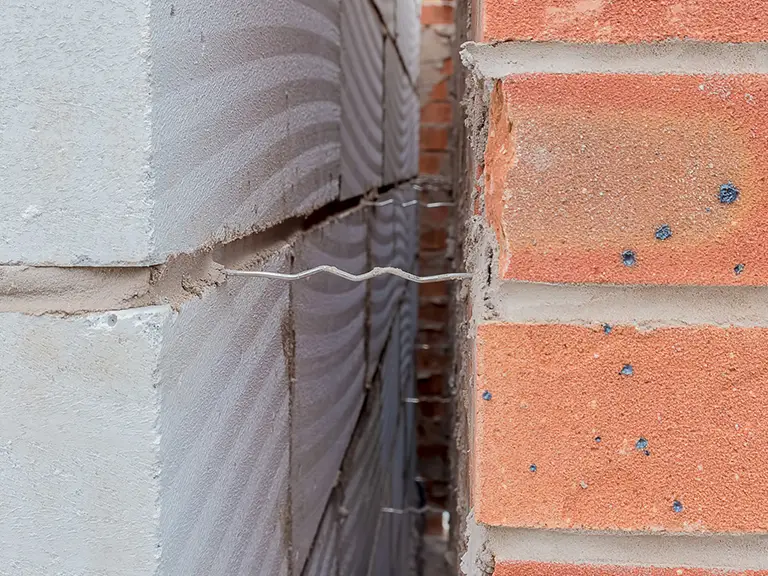
A homeowner may first notice a horizontal crack across the brickwork or a slight change in wall alignment. These early signs can indicate cavity wall tie failure, which occurs when the metal connectors linking the inner and outer leaves of a cavity wall lose strength due to corrosion, material fatigue, or age. As the ties deteriorate, the stability of the external masonry reduces and movement in the wall can develop, sometimes before the damage is obvious on the surface.
The English Housing Survey is a continuous national survey that has monitored housing circumstances and the condition of homes in England for more than 50 years [1]. The resource provides an evidence base for understanding defects and disrepair in the housing stock. Approved Document A to the Building Regulations sets out how masonry cavity walls must be designed and built to remain stable, including requirements for cavity width, wall thickness and stainless steel wall ties that are correctly specified and spaced to BS EN 845 1 [2]. Together, these references underline the importance of well-designed cavity walls and correctly performing wall ties in maintaining structural stability.
For these reasons, professional inspection is recommended when cracking, bulging or distortion is observed. A formal structural assessment can confirm whether cavity wall tie failure is present, identify any related issues, and specify appropriate remedial work to stabilise the wall.
Structural Risks of Cavity Wall Tie Failure
Wall ties provide essential restraint between the two leaves of a cavity wall, ensuring the structure performs as a single, stable unit. When the ties corrode or weaken, the outer leaf can begin to move independently. This may lead to cracking, distortion and, in more advanced cases, outward bulging of the masonry. Deterioration often progresses inside the wall long before surface changes appear.
When cavity wall tie failure progresses, the effects are not limited to external brickwork. Distortion can place additional stress on lintels, window frames and internal finishes, increasing the likelihood of secondary cracking and localised deformation. In more advanced cases, loss of restraint may require partial rebuilding of affected walls to restore structural performance and safety.
There can also be practical implications for property transactions and asset management. Survey reports that identify significant wall movement or instability may affect lending decisions, insurance conditions and planned refurbishment programmes. Understanding the seriousness of cavity wall tie failure enables owners and managers to plan remedial work in a controlled, compliant way rather than responding to urgent structural problems later.
How Cavity Wall Ties Support Structural Stability
Cavity wall ties must be correctly specified and installed if masonry walls are to perform as intended. Guidance from Local Authority Building Control (LABC) notes that incorrect specification or poor installation can lead to moisture ingress or structural failure of masonry wall panels [3]. To comply with Building Regulation 7, work should be carried out using suitable materials, with installers following manufacturers’ instructions and workmanship standards such as BS 8000 3, particularly where ties form part of a proprietary system.
LABC also highlights key rules on tie spacing and embedment. For typical masonry cavity walls with leaves at least 90mm thick, Approved Document A and BS 8000 3 recommend a maximum horizontal spacing of 900mm and a maximum vertical spacing of 450mm, giving at least 2.5 wall ties per square metre. Ties should sit at least 50mm into each leaf, be placed within 225mm of vertical edges and roof verges, and be installed so that the drip lies centrally in the cavity and slopes slightly towards the outer leaf. Cavities should be kept clear so that ties do not become bridges for moisture or compromise long-term performance.
Recognising the Warning Signs of Cavity Wall Tie Failure
Cavity wall tie failure often becomes visible only after the wall has already lost part of its structural restraint. Early indicators usually appear in the mortar joints or around openings, where the outer leaf is more sensitive to movement. These changes can be mistaken for general settlement, which is why a formal inspection is important when defects begin to appear.
Typical warning signs include:
- Horizontal cracking that follows the mortar bed
- Stepped cracking near windows and doors
- Outward bulging or a slight lean in the external brickwork
- Rust staining or discolouration that suggests corroding metal
- Separation between brick courses or distortion along a wall
If deterioration continues, movement can increase, and further damage can develop. Bulging masonry, distortion around openings and localised instability may arise as the wall loses restraint. These issues can affect the overall structure and increase remedial costs, particularly if rebuilding or extensive reinforcement is required.
When warning signs are identified, it is helpful to document their location, extent and any changes over time. Photographs, simple elevation sketches and notes about when cracks first appeared can assist the surveyor in forming an accurate diagnosis. This record, combined with a structured inspection, supports a clear understanding of how far deterioration has progressed and which sections of the wall require remedial work.
Arranging a Professional Cavity Wall Tie Inspection
Diagnosis of cavity wall tie failure should be carried out by a qualified surveyor. A structured inspection reviews cracking, bulging and distortion around openings, and may use a borescope to examine embedded metal ties within the cavity. This confirms the condition and spacing of existing ties and whether remedial work is required, typically by installing new stainless-steel remedial ties and isolating defective ones to prevent further corrosion damage to the masonry.
Prokil provides survey-led assessment and structural repair advice across the South of England. Surveyors inspect cavity walls, identify whether defects relate to cavity wall tie failure or another issue, and issue clear written reports. To see for yourself, please visit our practical case studies.
Call 0800 048 9488 or arrange an inspection to obtain a formal cavity wall assessment.
External Sources
[1] GOV.UK, “The English Housing Survey”: https://www.gov.uk/government/collections/english-housing-survey
[2] GOV.UK, “Approved Document A to the Building Regulations”: https://www.gov.uk/government/publications/structure-approved-document-a
[3] Local Authority Building Control (LABC): https://www.labc.co.uk/news/installing-cavity-wall-ties-masonry-walls-0